
A number of concerned anglers have made me aware of this document
It is very important that we have a strong turnout at the upcoming SOTL Meeting.
It will be recorded for the record
It will be recorded for the record
Follow The Money
The constant attack on the fisheries division and fish culture is a vicious cycle that has an eroding effect on the Department’s ability to maintain current funding sources for the budget and negatively impacts the Vermont state and local economies.
Cutting fish culture staff and proposing fish culture station closures will negatively affect license sales and adversely affect the Department budget. Reducing license sales will decrease matching funds for the Department. The Department’s solvency and relevancy is undeniably linked to participation. “Participation” in fishing means license sales, as you can’t participate without one. The willingness of the public to buy a license and go fishing is 100% driven by opportunity. Without quality fishing opportunities in Vermont waters, we wouldn’t be able to motivate anglers to go fishing, and so we wouldn’t sell as many licenses. Whether it’s fish culture and stocking or fisheries management activities, if you cut resources and impair the Fisheries Division’s ability to effectively provide quality fishing opportunities in Vermont, the end result is the direct undermining of the department’s budget. Which in turn leads to fewer quality fishing opportunities, which results in fewer license sales. It’s a Catch-22 at all levels. For every $1 dollar sold in licenses $3 dollars become available in federal DJ funds through the Wildlife and Sport Fish Restoration Program. But you need participation (aka license sales) to pull in that money by generating, maintaining, and even increasing fishing participation. The bottom line - if you don’t have the fish, you don’t sell the licenses.
People fishing in Vermont, by sheer numbers of participants, are by far the largest supporters of the Vermont Fish and Wildlife Department. Beyond direct income from license sales, anglers’ support of fish division initiatives has leveraged over $4.8 million dollars in federal funds for FY27.
It should also be recognized that anglers are also the largest contributors to the Department’s Habitat Stamp initiative since its inception in 2015.You don’t need to buy a license to buy a Habitat Stamp, but data from 2024 indicates that 95% of Habitat Stamps purchased are by license holders, with a significant majority being represented by fishing license holders. The Vermont Habitat Stamp raised $243,888 dollars in 2024 and leveraged an additional $171,266 federal match, totaling more than $415,000 for the Vermont Fish and Wildlife Department’s land conservation and habitat improvement efforts.
The angling public has continually supported the efforts of the Fish Division. Within this division, fisheries management and fish production work together to provide quality fishing in Vermont waters. Stocking fish for recreational opportunities was recognized as important to 80% of anglers who fish rivers and streams in Vermont as published in the most recent Department Angler Survey.
Recreational sport fishing is not only a key part of Vermont’s outdoor heritage but also an important part of Vermont’s economy. According to the 2016 United States Fish & Wildlife Service’s National Survey of Hunting, Fishing, and Wildlife-Associated Recreation, coupled with the 2020 Vermont Angler Survey, the Vermont fish culture program generates approximately $39.6 M worth of annual economic benefit to the state of Vermont. Given that the fish culture program has a $4.2 M yearly budget with a 60% federal match ratio ($2.5M), the State of Vermont’s annual fish culture return on investment ratio is nearly 23:1.
In addition to these values, a 2016 study on “The Value of Lake Champlain” by The Nelson A. Rockefeller Center at Dartmouth College showed that a value of $205M of annual economic benefit to the state of Vermont was attributed to fishing solely for Lake Champlain. If even just a quarter of the $205M fishing value for Lake Champlain was attributed directly to fish culture programs in Vermont and New York that stock a variety of sought-after game fish within the basin area, over $51M annually could be attributed directly to hatchery-reared fish.
Recent economic/participation data (2022) from the American Sportfish Association and the USFWS:
With that kind of economic benefit, what could be the rationale for the current budget being proposed for Fish and Wildlife in particular the Fish Division decrease?
Here is a comparison of the Fish and Wildlife FY26 and FY27 Budgets:
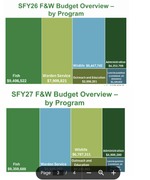
Warden Service – Proposed budget increase of $735,446
Wildlife Division – Proposed budget increase of $339,569
Outreach and Education Division – Proposed budget increase of $137,764
Administration – Proposed budget increase of $656,511
Fish Division - Proposed budget decrease of $46,834
The decrease of $46,834 from the Fish Division also includes proposing a RIF of an employee at Ed Weed FCS, continue freezing a position at Bald Hill FCS, reallocating the manager position from Salisbury FCS elsewhere in the Department because it was going to be closed due to the “bugs” and significant savings on 5 long tenured employees recently retiring……….
Where is all that money going?
The budget problem facing the Department is not a Fish Culture/Fish Division problem. The Fish Culture/Fish Division is and has always been a financial stronghold of the Department, paying for itself many times annually if the overall economic benefits to the Vermont economy are considered.
To quote the Governor’s recent Budget Address: “There are pockets of money in every agency, department and division that will make a real difference for all of us”.
Looking specifically at the Fish Culture program within the Fish Division, is there any other pocket of money within the Agency or Vermont state government with a better return on investment? Whether you fish or not, fish culture makes a real difference for all of us in Vermont.